Back to blog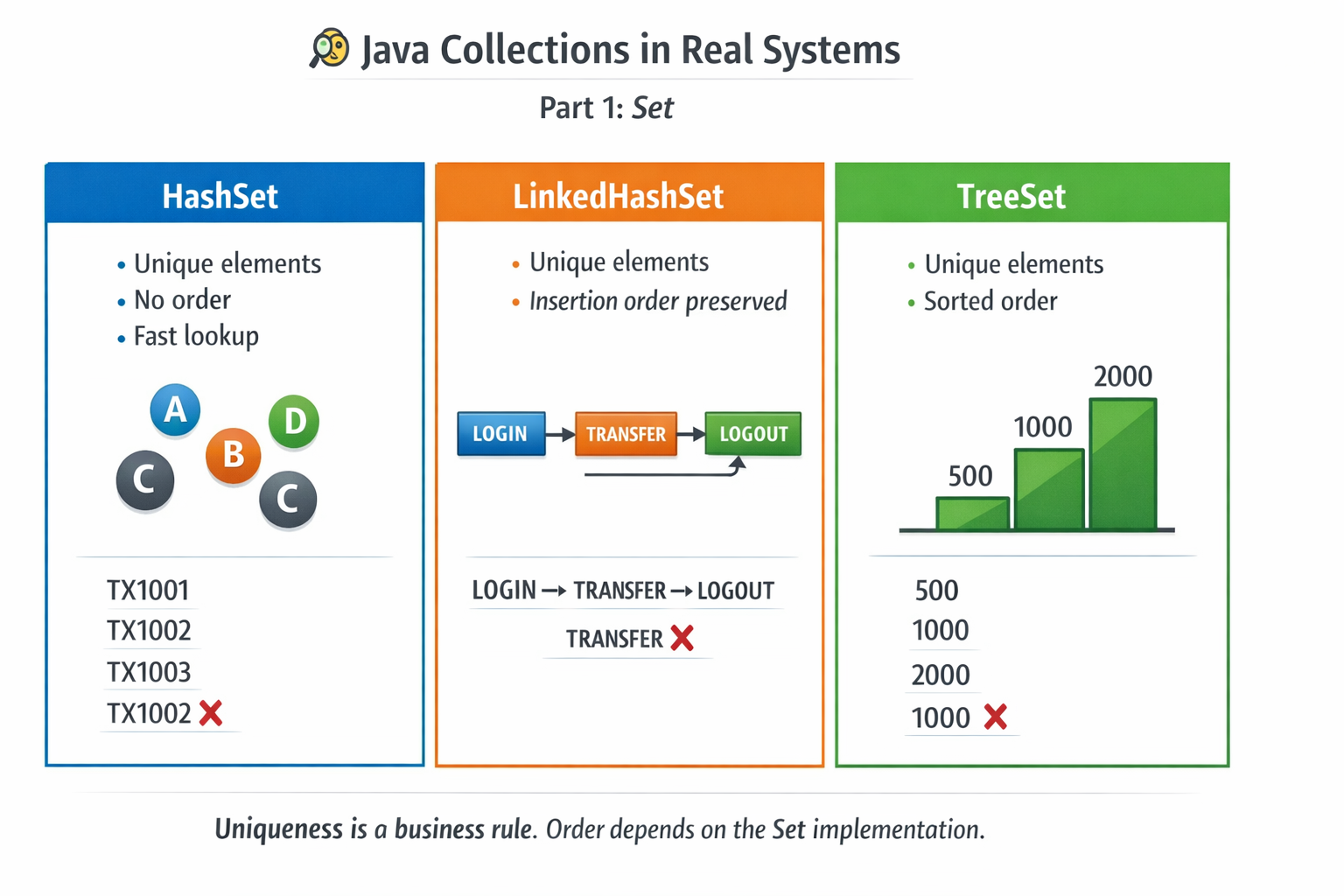
Collection of unique elements only No access by index Ordering depends on the chosen implementation No guaranteed order Very fast add, remove, and contains (average O(1)) Use case: preventing duplicate transaction processing Preserves insertion order Slightly slower than HashSet Use case: audit events with traceability Elements stored in sorted order Uses natural ordering or Comparator Use case: sorted limits or thresholds HashSet → fastest uniqueness guarantee LinkedHashSet → uniqueness + order TreeSet → uniqueness + sorting
January 8, 2026•6 min read•Marina
Java Collections in Real Systems | Part 1: Set
JavaCollectionsSet
Java Collections in Real Systems | Part 1: Set
When working with Java, choosing the right collection is not an implementation detail. It is a modeling decision.
This is the first post in a short series about Java Collections and how they translate into real-world systems, especially in financial services.
Set is the right choice when uniqueness is a business rule, not just a technical constraint.
Set
HashSet
Set<String> processedTransactions = new HashSet<>();
processedTransactions.add("TX1001");
processedTransactions.add("TX1002");
processedTransactions.add("TX1003");
processedTransactions.add("TX1002"); // duplicate ignored
LinkedHashSet
Set<String> auditEvents = new LinkedHashSet<>();
auditEvents.add("LOGIN");
auditEvents.add("TRANSFER");
auditEvents.add("LOGOUT");
auditEvents.add("TRANSFER"); // duplicate ignored, order preserved
TreeSet
Set<BigDecimal> limits = new TreeSet<>();
limits.add(new BigDecimal("1000"));
limits.add(new BigDecimal("500"));
limits.add(new BigDecimal("2000"));
limits.add(new BigDecimal("1000")); // duplicate ignored
Think
If you want the big-picture comparison between List, Set, and Map, read the intro:
List, Set, and Map: Key Differences in Java Collections.
Next in the series: